
One effective way to empower our AI agents is by connecting them to external tools via the Model Context Protocol (MCP). While their built-in features are already capable, integrating the right MCP tools dramatically expands what they can do, allowing our AI agents to move beyond basic outputs and deliver closer to complete, finished products. For me, this shifts how I am thinking about Human+AI models of work, because we are using natural language prompting to act as orchestrators in collaboration with our AI agents to unlock even more potential.
This interconnectivity is where the true value emerges. Connect an agent to your databases and document software, and it can query live records to compile fully formatted reports. Pair it with presentation files and creative tools, and it can transform static slide decks into dynamic motion graphics. In other words, any tools with MCP can be used as a data source or as a productivity suite by your AI agent, expanding its capabilities for you to prompt. Here’s a graphic of what that might look like in practice, specifically when thinking about the Human+AI orchestrator model:
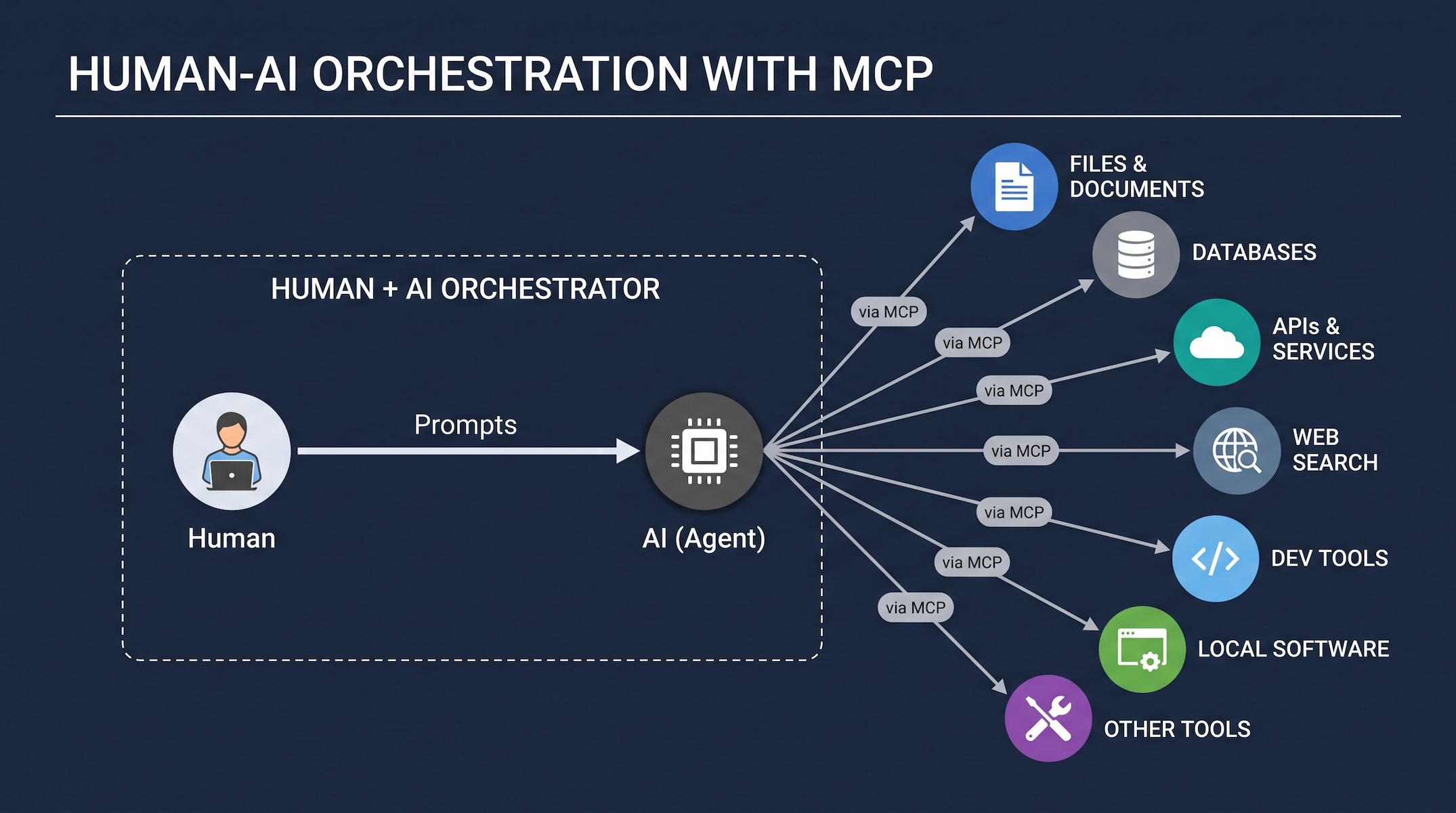
Within Human+AI Orchestrator, a human prompts the AI, which uses MCP to connect directly and orchestrate diverse tool types, from databases to local software.
For me, the first moment of realization of what was possible occurred in April 2026 when I watched Nate Herk share how he was handing off his YouTube video editing to Claude, including the production of motion graphics for his videos. This video is still an excellent introductory example of what is possible:
A few months later, with the release of Claude Fable, Nate shared the evolution of his process and what he was testing—full end-to-end video production via AI agent:
These two videos also demonstrate what happens to the Human+AI orchestrator paradigm as the “intelligence” of the AI models grows. More complex AI agents can handle more complex orchestration tasks.
It is both amazing and a bit frightening what is possible now. Specifically, how little input is required to produce polished products. This is where my previous post on Optimal Human Input comes into play because, as Human+AI orchestration expands, we need to be thinking about what aspects of the work are critical for humans to provide. Polished AI products from minimal input can be misleading and wasteful when they still miss the mark. Supplying rich context, relevant examples, and clear constraints represents the exact kind of intentional human guidance needed to turn raw AI capability into genuine value.
Another consideration is that many folks are using MCP without even realizing they have this configured since it is often labeled as “Connectors” or “Connected Apps.” In many cases, these connections have data and privacy implications—looking at you Gemini Personal Intelligence! I bring this to light because we also need to critically consider what tools our AI agents can access based around the data we want accessible to the various companies. I’ve used a handful of local softwares in the past with MCP capabilities and I’ve felt more comfortable experimenting with them because I’m keeping data local. For example, when version 0.5 of VoiceBox launched, it was one of the first tools with which I intentionally explored the MCP capabilities. Local models powering local voice cloning helped me understand what such tools are capable of. Recently, the release of the Craft App clones of Adobe’s software also brought MCP capabilities to local production software. Giving your AI agent access to a local video editor and photo editor can lead to some very interesting products, especially if you are pulling from rich data sources from other MCP enabled tools.
If you are curious about exploring MCP, start by asking your AI agent what tools it can access right now and how to connect new ones. The agents themselves are often the best guides for expanding our capabilities as orchestrators in this interconnected world.